This explainer walks through slide 9 of the investor blueprint deck our team uses with prospective cabin owners. The complete, slide-by-slide version is on the blog: Building High-Yield Rental Cabins in the Smoky Mountains: The Investor Blueprint. Every claim below stays inside what the deck itself shows — if a figure is not on these slides, we point you to the post or tool that carries it.
The Contractor Decision Is a Six-Figure Decision
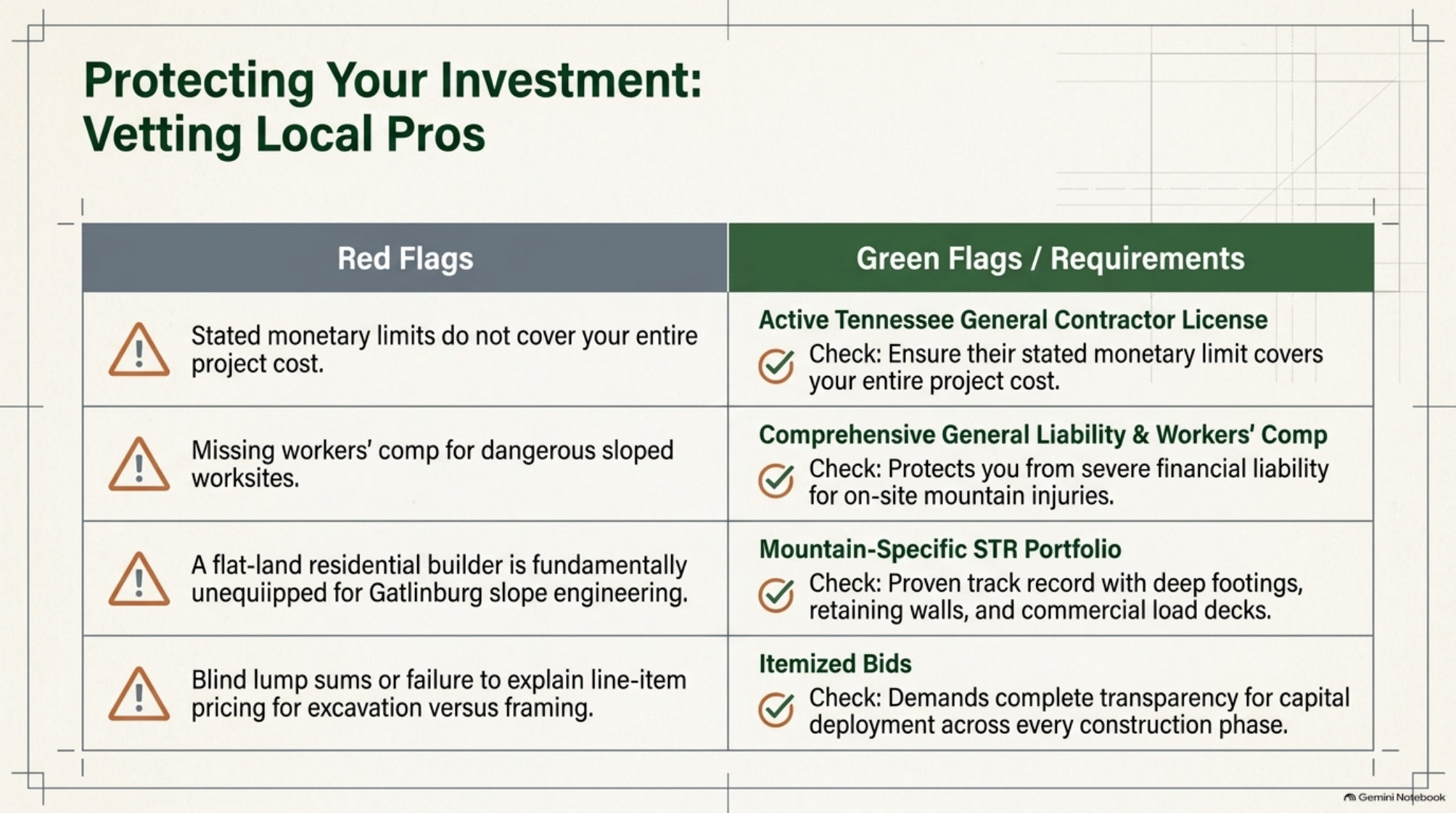
Slide 9 of the deck is titled “Protecting Your Investment: Vetting Local Pros,” and it earns the title. On a mountain lot, the contractor you choose decides not just the price but whether the cabin stands, drains, and passes inspection. The deck organizes the vetting into four green-flag requirements with a red flag under each one. Run all four against every bidder, in writing, before you sign anything.
Green Flag 1: A Tennessee General Contractor License That Covers the Whole Project
The first requirement is an active Tennessee general contractor license — and the detail that filters out more builders than the license itself: the stated monetary limit on it. Tennessee licenses carry monetary limits, and the deck is explicit about what to check: ensure their stated limit covers your entire project cost.
A builder whose license tops out below your build size is not licensed for your project, no matter how good their references are. The red flag on this line is a stated limit that does not cover your full project cost — which means the builder is either operating beyond their license or planning to split the work in ways that push risk onto you. Ask to see the license document, read the limit yourself, and compare it to the realistic total from the 2026 cost post before you proceed.
Green Flag 2: Comprehensive General Liability and Workers’ Comp
The second requirement is comprehensive general liability insurance plus workers’ compensation coverage. The deck’s red flag explains why the workers’ comp half is non-negotiable: a missing workers’ comp policy on a dangerous sloped worksite leaves you exposed to severe financial liability for on-site mountain injuries.
Here is how that plays out in the worst case: a framer falls on your hillside, and if the contractor has no workers’ comp, the injured worker’s medical bills and lost wages can come looking for the deepest pocket on the site — which is the property owner. General liability covers damage the contractor causes to your property and others; it does not cover the contractor’s own employees. You want to see both certificates, current, with your project named as an insured interest where the policy allows.
Green Flag 3: A Mountain-Specific STR Portfolio
The third check is the one that separates Gatlinburg contractors from everyone else: a proven track record of mountain STR work with deep footings, retaining walls, and commercial-load decks. The deck’s red flag is blunt: a flat-land residential builder is fundamentally unequipped for Gatlinburg slope engineering.
A flat lot and a mountain lot are different engineering problems. Slope work means stepped and deepened footings that tie into the hillside, retaining walls that hold the build pad, drainage that keeps water off the foundation, and decks engineered for commercial loads — the 100+ psf live-load standard a filled hot tub demands, not the 40 psf a flat-land porch gets. Ask for completed cabins on slopes comparable to yours, visit one, and talk to its owner about how the builder handled the site-work phase. The steep-slope excavation estimator shows what that phase involves before you ever see a bid.
Green Flag 4: Itemized Bids That Explain Themselves
The fourth requirement is complete transparency in pricing: itemized bids that deploy capital across every construction phase and explain line-item pricing for excavation versus framing. The red flag on this line is the blind lump sum — a single number with no breakdown — or a bidder who cannot explain what the line items mean.
Itemization matters because mountain builds concentrate cost in the places owners least expect it. Service phases in Gatlinburg typically run from $15,000 to $35,000+ per specialized phase depending on lot complexity and material selection, and the expensive surprises live in the site work. The worked example in our 2026 cost post — a 2,200 sq ft luxury cabin on an 18 percent slope at $835,406 — shows how fast dirt and access eat a budget: 600 cubic yards of excavation at $35 per yard, plus three days of a 90-ton crane at $2,800 per day, before a single log is set. An itemized bid shows you that money line by line; a lump sum hides it until the change order arrives.
Run the Scorecard and Take the Bids
The deck turns all four checks into a scored worksheet, and you can run it against every bidder today: our 50-point contractor vetting scorecard walks each requirement — license limit, insurance, portfolio evidence, and bid transparency — as scored questions, so you compare candidates on the same rubric instead of on salesmanship.
When you are ready, call (865) 601-8816. We match buyers exclusively with strictly pre-vetted, fully licensed Gatlinburg log home professionals and get you up to three itemized quotes within one business day, so you review the field at your own pace with zero obligation.
Frequently Asked Questions
What exactly is a general contractor license monetary limit?
Tennessee’s licensing board issues general contractor licenses with a stated monetary limit — the maximum project value the license covers. Your check is simple: the limit must be at least your full project cost. A builder with a lower limit is not licensed to carry your project, regardless of experience.
If the builder has general liability, why do I also need workers’ comp?
They cover different risks. General liability protects against damage to property and third parties. Workers’ compensation covers the contractor’s own employees when they are injured on the job. On a sloped mountain site, employee injuries are the realistic risk, and without workers’ comp that liability can land on the property owner. Carry both, and verify both certificates.
Why does a flat-land builder fail on mountain lots even with a license?
Because slope engineering is a different discipline: deep footings tied into the hillside, engineered retaining walls, drainage management, and commercial-load deck structures are not part of typical flat-ground residential work. The deck’s test is a proven portfolio of mountain STR cabins — completed projects you can visit — not a license alone.