Ask five people what a log home costs and you will get five answers, most of them wrong. That is not because the numbers are secret. It is because most published prices stop at the logs and never touch the slope, the site work, or the finishes. This post walks through the 2026 numbers we budget with for real builds in Gatlinburg and Sevier County: the base rate for each build style, what a steep lot adds, and a full worked budget for the floor plan we build more than any other: 2,200 sq ft. If you only remember one sentence, make it this one: the per-sq-ft number in a magazine ad is the start of the conversation, not the price of the house.
Three Build Styles, Three Base Rates
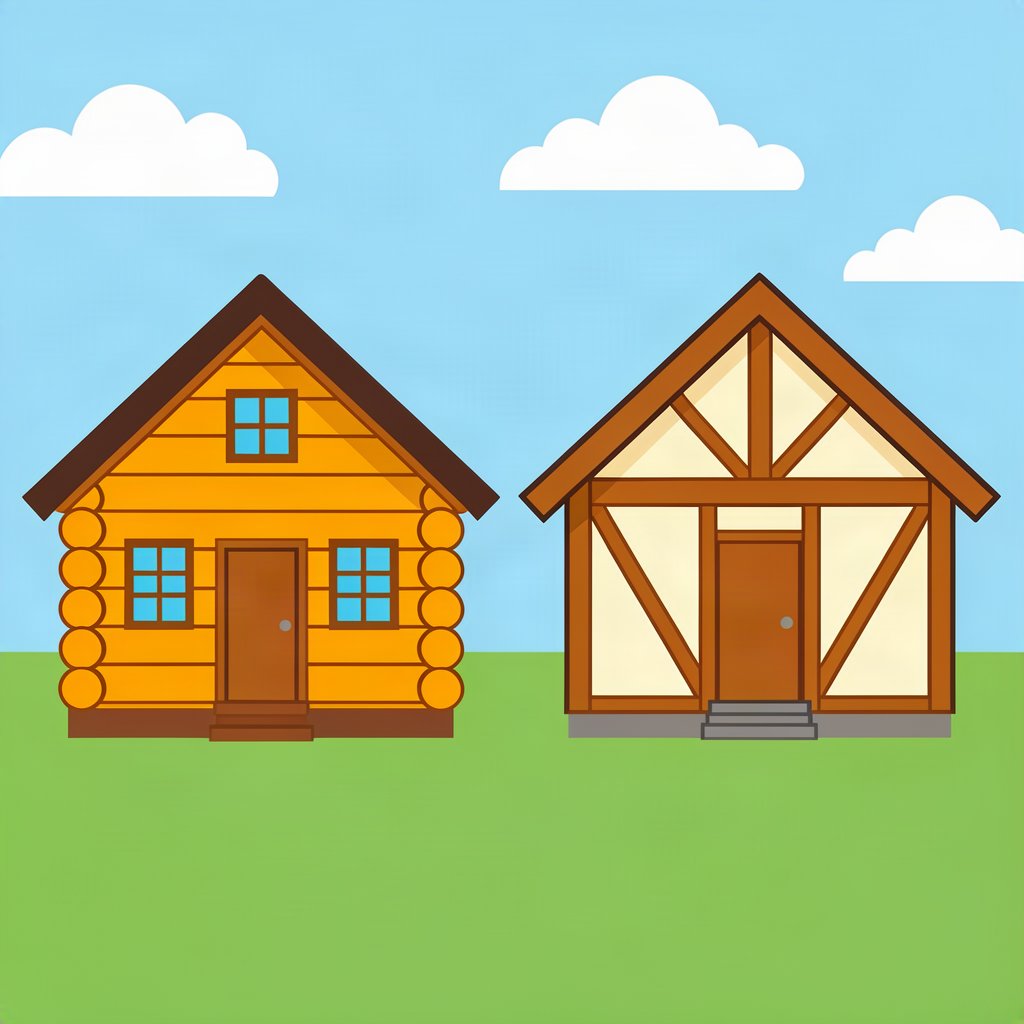
Every budget starts with the build method, because the method sets your price per sq ft. These are the audited base rates for 2026 in the Smoky Mountains:
| Build Style | Base Cost per Sq Ft | What It Is |
|---|---|---|
| Full-scribe (handcrafted) | $260 | Each log is scribed and hand-fit to the log below it, so the wall interlocks tight. No chinking between courses. |
| Chinked (milled) | $220 | Machine-milled logs stacked with uniform seams, sealed with chinking and backer rod. The most budget-friendly way to get a real log wall. |
| Timber-frame | $285 | Heavy post-and-beam frame with insulated infill panels. Big open spans, more glass, and a higher price per sq ft to match. |
Those rates assume a buildable lot with reasonable access and standard finishes. Two adjustments come next, and both are multipliers on the base rate: your slope and your finish tier. Standard finishes carry a 1.0 multiplier. Luxury short-term-rental finishes add 15 percent (a 1.15 multiplier), and high-end finishes add 30 percent (1.30). Together, slope and finishes separate a realistic budget from a fantasy one.
Slope Is the Line Item Most Budgets Miss
Gatlinburg lots slope. That is the trade you make for the views, and it shows up in every phase of the budget. Our cost model adds roughly 1.5 percent to the build total for every point of slope. An 18 percent grade, which is common on ridge lots around the Smokies, adds 27 percent. In multiplier terms: 1.27.
To picture the grade, 18 percent means the lot drops 18 ft for every 100 ft you walk across it. Now imagine footing trenches, equipment, and material deliveries on that ground. That 27 percent buys real things:
- Deeper footings and stepped foundations that follow the grade instead of fighting it
- Engineered retaining walls to hold the hillside in place
- Excavation and crane time a flat lot never needs
Here is what that looked like on the last 18 percent-slope build we priced: 600 cu yd of excavation at $35 per cu yd comes to $21,000. A 90-ton crane on site for 3 days at $2,800 per day comes to $8,400. Site machinery alone: $29,400, before a single log is set. The crane days stack up fast, too: one day for the lift, a second when the slope is 10 percent or worse, and a third when the set point sits more than 150 ft from the road, which it usually does on a mountain lot. Add the foundation package for a 2,200 sq ft cabin, which typically lands between $28,000 and $35,000 on a moderate lot, and you can see why a cheap steep lot regularly ends up costing more than an expensive flat one.
If your lot is steep, run the real numbers before you commit: our steep-slope excavation and crane logistics estimator walks through the cubic yards, retaining walls, and crane days your specific grade will demand.
Worked Example: 2,200 Sq Ft Luxury Full-Scribe on an 18% Slope
Take the floor plan we build most often, 2,200 sq ft, and price it as a luxury full-scribe cabin on an 18 percent slope. The math runs in three clean steps:
- Base shell: 2,200 sq ft x $260 = $572,000
- Slope multiplier: $572,000 x 1.27 = $726,440
- Luxury STR finishes: $726,440 x 1.15 = $835,406
Per sq ft, that is $379.73 ($835,406 divided by 2,200). Round it and you have the working number: roughly $380 per sq ft for this house on this lot, fully finished and ready for guests. Want the same cabin in a different method? The math runs identically off the other base rates. A chinked build comes to 2,200 x $220 = $484,000, then x 1.27 for slope = $614,680, then x 1.15 for luxury finishes = $706,882, or about $321 per sq ft. A timber-frame version lands at 2,200 x $285 = $627,000, then x 1.27 = $796,290, then x 1.15 = $915,734, or about $416 per sq ft. Same floor plan, same lot, same finishes: a $209,000 spread between the cheapest and most expensive build style, which is why the method decision belongs at the very top of the budget.
One thing needs to be said plainly: the $835,406 figure is the construction budget. It does not include land, septic, or permits. Those are separate line items, and pretending otherwise is how build budgets die in the first meeting with a lender.
You can rebuild this exact math for your own floor plan, slope, and finish tier with our turnkey log home construction cost estimator. It uses the same audited rates and multipliers behind this post.
Where the Money Goes: Four Phases
Once the total is real, the draw schedule should be too. We split every build into four phases, and lenders like to see the same split when they underwrite the loan:
- 35% log package and shell. The structure itself: logs, wall erection, floors, and roof. The log package delivered to the site for a 2,200 sq ft floor plan typically runs $32,000 to $42,000; the rest of the phase is the crew time to set it. Before you order, size the package from your own floor plan with our log package and linear footage estimator, which figures wall perimeter, courses, and board feet.
- 20% foundation and site. Excavation, footings, retaining walls, and grading. The most variable phase on any mountain lot, for the reasons above.
- 25% mechanicals. HVAC, plumbing, and electrical, sized for full-time occupancy and guest loads.
- 20% finishes. Flooring, cabinets, baths, and the rental-grade details guests actually review. This is the phase that earns the review score, and the one people trim first when the earlier phases run over.
Notice that the first two phases eat 55 percent of the budget. That front-loading is normal: the heavy money leaves your account early, and it carries interest the longest. Budget and schedule accordingly, or the finish phase is the one that starves.
Get a Number You Can Take to the Bank
No budget survives contact with a mountain lot completely unchanged, but the figures above are audited against real 2026 pricing, and they match what our estimator returns. If you want a straight answer about what your specific lot will cost to build, call (865) 601-8816 and ask. Or price it yourself in the turnkey estimator first, so the conversation starts from your number, not a guess.
Frequently Asked Questions
What does the $260 per sq ft full-scribe rate actually include?
The base rate prices the log home shell at standard finishes on a buildable lot: the logs, the wall erection, floors, and roof. It does not include the slope multiplier, a luxury finish tier, land, septic, or permits. The worked example shows the difference those add-ons make: $572,000 of shell becomes $835,406 once an 18 percent slope and luxury finishes are applied.
Why does an 18 percent slope add 27 percent to the build?
Each point of slope adds roughly 1.5 percent to the total, so 18 points of slope adds 27 percent, or a 1.27 multiplier. That extra money covers deeper stepped footings, engineered retaining walls, and the excavation and crane work a hillside demands. On our example lot, excavation and crane alone ran $29,400 for 600 cu yd of dirt and 3 days of a 90-ton crane.
Does the $835,406 example include land, septic, and permits?
No. It covers construction only: shell, site work, mechanicals, and finishes at luxury level on an 18 percent slope. Land is priced by the lot, septic design depends on your soil test, and permits follow Sevier County's fee schedule and review process. Treat each as a separate line item on top of the construction total.