This explainer walks through slides 2 and 3 of the investor blueprint deck our team uses with prospective cabin owners. The complete, slide-by-slide version is on the blog: Building High-Yield Rental Cabins in the Smoky Mountains: The Investor Blueprint. Every claim below stays inside what the deck itself shows — if a figure is not on these slides, we point you to the post or tool that carries it.
Record Visitation That Never Really Ends
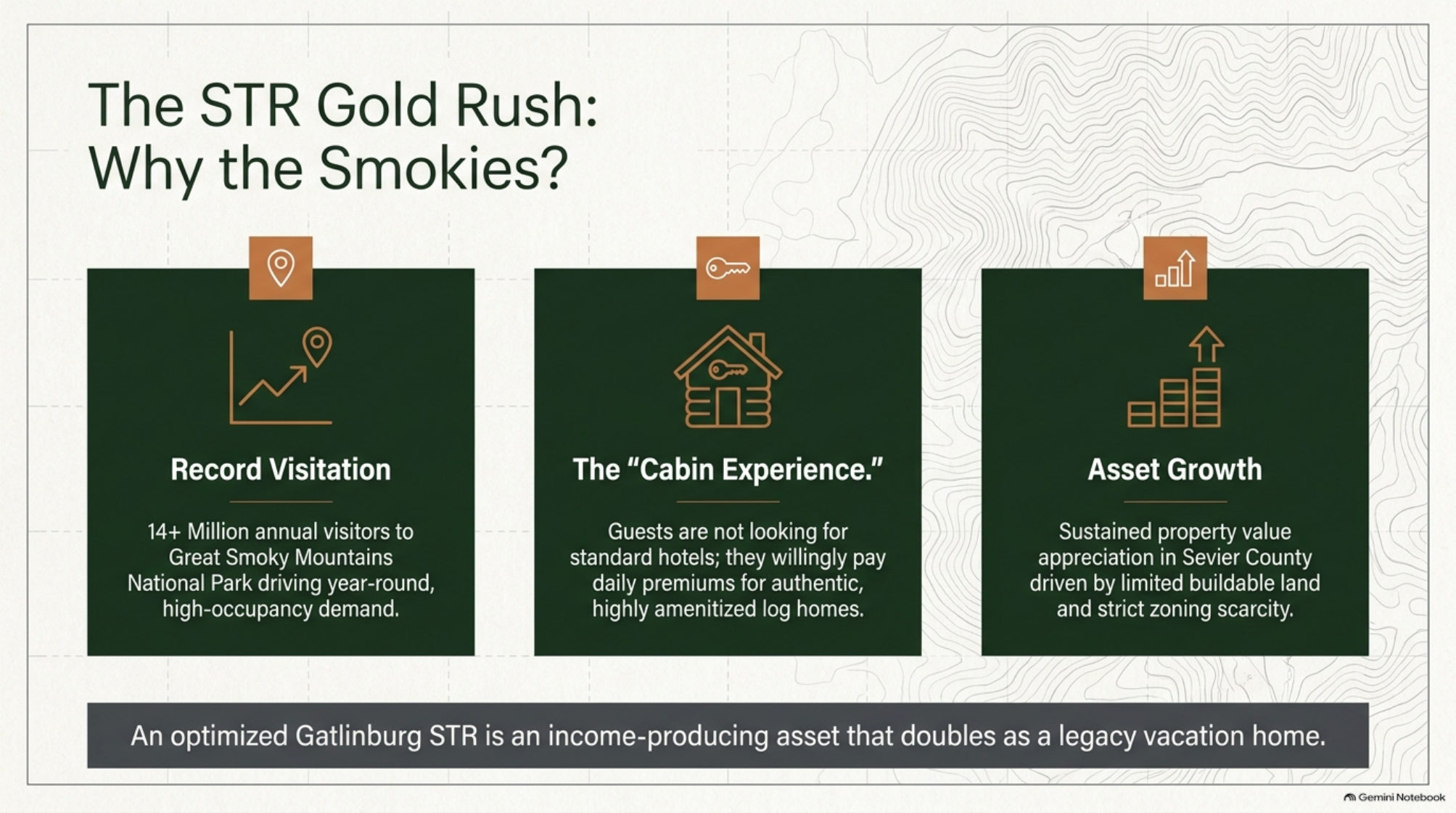
Slide 2 of the deck opens with the number that makes the whole market work: more than 14 million visitors a year reach Great Smoky Mountains National Park, and that traffic is not a summer spike. Demand runs year-round and holds high occupancy across the calendar. Spring break weeks, summer family trips, October color season, and the winter holiday stretch all put heads in beds, which matters enormously to an owner: a cabin that books in four seasons earns over a much flatter curve than one that lives and dies on a single tourist window.
The practical reading for 2026 is that the demand side of the Smokies is not the risky part of the investment. The park has no seasonal gate that closes the market, and the vacation-rental audience keeps renewing itself with new families who have never stayed in a cabin before. When we underwrite a rental cabin for an owner, we start from that year-round occupancy base and then layer the two other advantages on slide 2 on top of it.
The Cabin Experience Commands a Daily Premium
The deck makes a direct claim that surprises first-time investors: guests are not looking for standard hotels. A Gatlinburg visitor can find a chain hotel room in minutes, yet travelers willingly pay a daily premium for an authentic, highly amenitized log home. That premium is the log-home premium, and it is the reason a well-built cabin out-earns an equivalently priced flat-ground house used for rentals.
What guests are actually buying is the full cabin experience: the log walls, the fireplace, the view deck, the game room, the hot tub, and the shared-memory trip that goes with them. Because those features decide nightly rate and review score, the floor plan and finish details you choose are revenue decisions, not style decisions. We cover the specific design choices that drive five-star reviews in the companion explainer to slide 5 of the same deck.
Appreciation on the Owner’s Side of the Ledger
The third pillar of slide 2 is asset growth. Sevier County property values have sustained appreciation, and the deck points to the two forces behind it: limited buildable land and strict zoning scarcity. Mountainsides can only hold so many cabins. Flat, buildable ground near the parkway is finite, and local zoning rules keep new supply from flooding the market even when demand is obvious. Fewer competing cabins means steadier occupancy and stronger resale values over the life of the asset.
Put the three pillars together and you get the deck’s summary line: an optimized Gatlinburg short-term rental is an income-producing asset that doubles as a legacy vacation home. The income covers the carrying costs, and the appreciation builds equity while your family uses it. If you want the income side modeled against your own floor plan, the turnkey cost estimator rebuilds the build math so the revenue conversation starts from a real number.
Slide 3: Match the Build Profile to Rental Durability
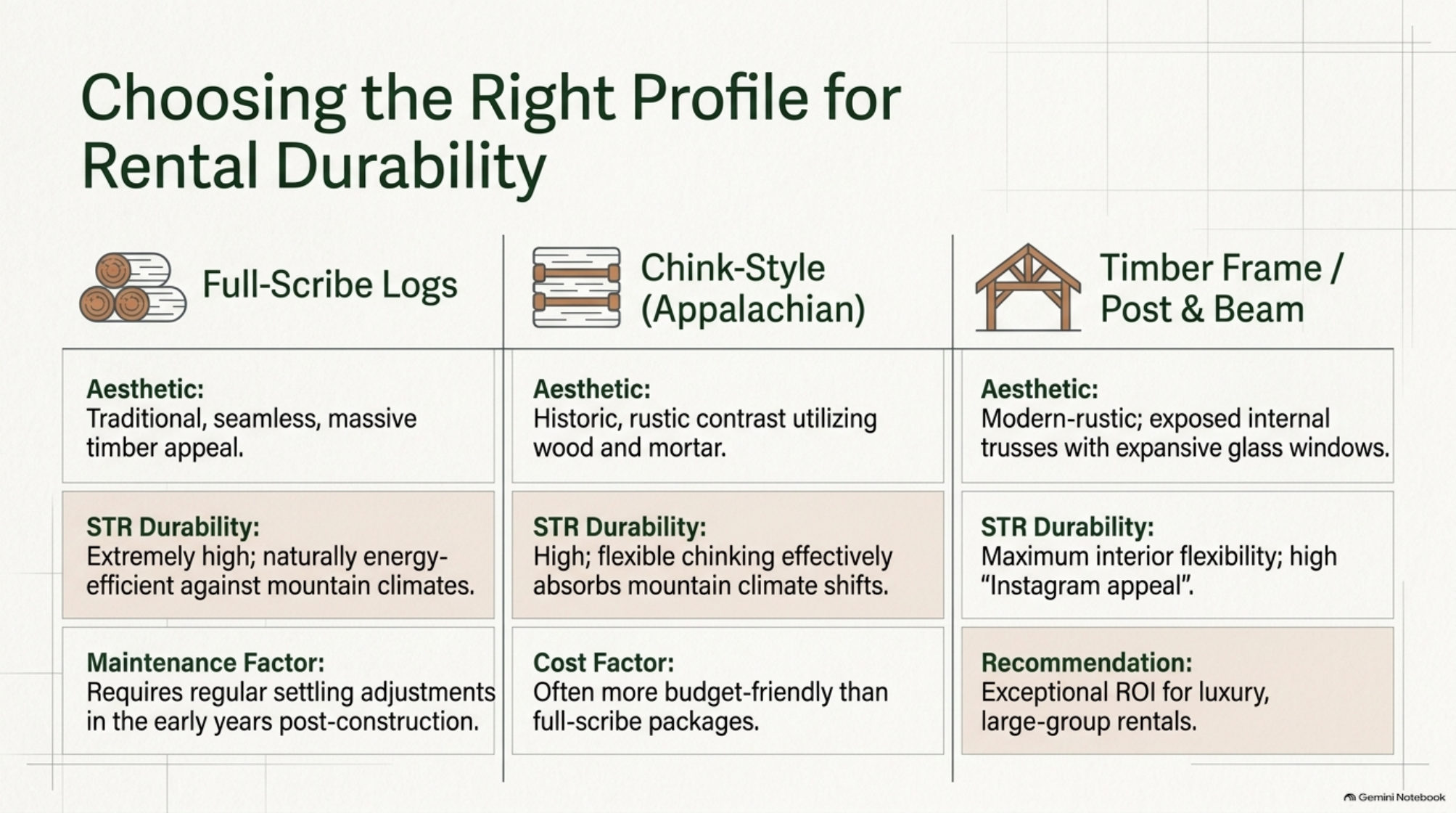
Demand gets you to the starting line; the build method decides how long the cabin stays competitive. Slide 3 compares the three profiles that dominate Smoky Mountain rentals, each scored for STR durability and maintenance burden.
Chink-style Appalachian logs deliver the traditional, massive timber look guests picture when they book a cabin. STR durability is extremely high: the logs are naturally energy-efficient against mountain climates, which trims the heating bills that eat into winter rental margins. The honest trade-offs are settling adjustments in the first few years after construction, and a cost profile that is often more budget-friendly than full-scribe packages.
Full-scribe handcrafted logs give the historic, rustic look of wood interlocked course over course with no chinking seams. You pay a premium for the handcrafted package, and owners accept a longer build schedule, but the durability ceiling is the highest of the three for a cabin that will be rented hard for decades.
Timber-frame post-and-beam is the modern-rustic option: exposed internal trusses and expansive glass that photographs beautifully. The open interiors give maximum flexibility for large-group layouts, which is why the deck flags exceptional ROI for luxury, large-group rentals and strong “Instagram appeal.” Our side-by-side log-vs-timber-frame comparison walks through the structural and cost differences in more depth.
What the 2026 Buyer Should Do With This
The market case on these two slides supports buying — provided the asset is built for the rental use, on ground that can be permitted, with a floor plan that earns the premium nightly rate. That is a chain of decisions: location within the Sevier County rental market, the build profile, the interior package that drives reviews, and compliance with local STR rules. Later slides of the deck cover each of those, and the explainers in this series walk through them one at a time.
If you are ready to move, call (865) 601-8816 and tell us your lot and timeline. We connect buyers with pre-vetted, fully licensed Gatlinburg log home professionals, and you compare up to three itemized quotes with no obligation.
Frequently Asked Questions
Is the 14-million-visitor figure really spread across the whole year?
The park sees strong traffic in every season. Spring breaks and summer vacations drive the warm months; October color season is famously the busiest stretch of the year; and winter holidays fill cabins with families and couples. The deck’s point is that Smokies demand is year-round rather than concentrated in one season, which is what keeps rental occupancy high across the calendar.
Why do guests pay more for a log cabin than a hotel?
Because the cabin is the vacation, not just a place to sleep. Guests traveling to the Smokies want the authentic cabin experience — logs, fireplaces, decks, hot tubs, space for the whole group — and they willingly pay a daily premium for it. That premium, not the room itself, is what drives the nightly rate on a rental cabin.
Which build profile should a first-time STR owner pick?
It depends on the budget and the guest profile. Chink-style logs are the workhorse for a budget-conscious cabin that still reads unmistakably as a log home. Full-scribe and timber-frame cost more and are favored for luxury, large-group rentals where premium rates and the guest experience justify the higher build cost. Review the cost post before you choose, because the gap between profiles is a six-figure decision.