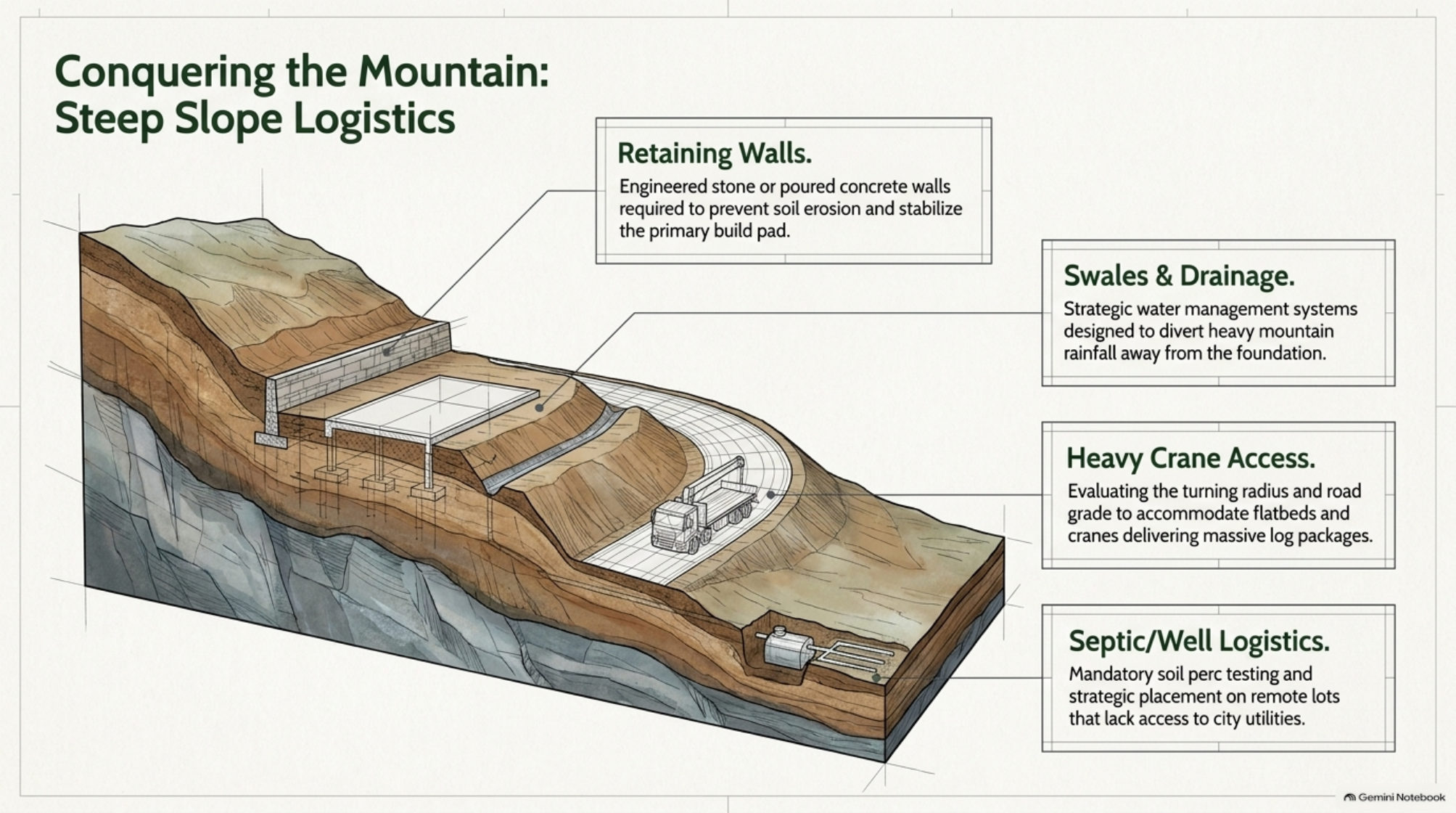
Slide 8 of our Building High-Yield Rental Cabins in the Smoky Mountains deck is the one about conquering the mountain: steep slope logistics. Flat lots hide their costs in the house; mountain lots hide them in the dirt, the drainage, and the road up to the pad. On a steep Gatlinburg lot, four systems decide whether the build goes smoothly: engineered retaining walls, swales and drainage, crane access, and septic and well logistics. Each one is a line item before the log package is ever ordered.
The reason this slide matters to investors is that slope work is invisible in the finished cabin but permanent in the budget. A cabin on a steep lot with a stable pad, dry foundation, and a road a crane can actually climb is worth every dollar of the site work. This post walks the four systems and then puts real numbers on the dirt and crane work.
Engineered Retaining Walls: Holding the Pad in Place
The deck calls for engineered stone or poured concrete walls to prevent soil erosion and stabilize the primary build pad. On a slope, the pad is cut into the hillside, which leaves a wall of soil on the uphill side that wants to move downhill. A retaining wall holds that soil back, and engineered means it is designed for the actual height, soil, and water pressure on your specific lot rather than built by eye.
Engineered walls are also foundation work in disguise: they protect the deep footings the house sits on, and they give the drainage system something to work with. On our worked example lot, this wall and grading work is a major reason site and foundation carries the largest single share of the budget at 35%, as detailed in our build phases and budget post.
Swales and Drainage: Moving Mountain Rain Away
Mountain rainfall is heavy and it arrives in bursts, so the second system is strategic water management: swales and drainage designed to divert that rainfall away from the foundation. A swale is a shallow, engineered channel that catches runoff and routes it around the structure instead of letting it pool against the footings or run down the cut face of the slope.
Drainage and retaining walls are designed together because water pressure is the main enemy of a retaining wall. Undrained soil behind a wall gets heavy when saturated and pushes harder; a swale that intercepts runoff uphill keeps the wall and the foundation dry. This is also the system that protects the investment over time, since water movement is what turns minor slope settling into cracked foundations and failing walls.
Crane Road Grade and Turning Radius: Getting the Logs to the Pad
Massive log packages arrive on flatbeds, and getting them up the mountain is a planning problem, not an accident. The deck is specific: evaluating the turning radius and road grade to accommodate flatbeds and cranes delivering massive log packages. A road that a pickup climbs easily can defeat a loaded flatbed, and a crane needs both a grade it can negotiate and a pad it can set up on without tipping.
On the worked example, the crane work is priced as a 90-ton crane for three days at $2,800 a day, which is $8,400 of the site budget before a log is set. Those crane days are non-negotiable on steep lots because the alternative, hand-setting logs or working them up the slope, is slower and riskier. Model your own grade and setbacks with our steep slope excavation and crane logistics estimator, which turns your lot measurements into a dirt and crane plan before you commit to a builder.
Septic and Well Logistics: Utilities on Remote Lots
Many mountain lots lack access to city utilities, which makes septic and well logistics a mandatory early step. The deck highlights mandatory soil perc testing: a perc test determines how fast water drains through your soil, which decides whether a conventional septic system is allowed and where the drain field can go. Fail the perc test and the options narrow to engineered systems, which cost more and need more room.
Well placement is a separate decision about drilling depth, water quality, and access for the drilling rig. Both systems have to be located before the pad is finalized, because the drain field needs downhill space and the well needs to stay clear of it. Getting perc testing done early is cheap insurance against designing a cabin that cannot be permitted on its own lot.
What the Dirt Work Really Costs
To close with real numbers: on the worked example lot in our cost model, the dirt work alone runs 600 cubic yards at $35 per yard, or $21,000 in excavation, and that is before the three days of 90-ton crane time at $2,800 a day add another $8,400. Together those two lines are nearly $30,000 of the site phase, and they do not include the retaining wall concrete, drainage, or the septic work. The full 2026 cost breakdown shows where those figures sit inside the complete $835,406 example.
The hot tub deck engineering discussed in our sister post on hot tub loads depends on this same site work, since deep footings can only do their job when the slope around them is stabilized and drained. On a mountain lot, the systems below grade decide how well everything above grade performs.
Frequently Asked Questions
Why do steep lots need engineered retaining walls instead of stacked blocks?
Stacked blocks without engineering are a landscaping product, not a structural one. A wall holding back a cut slope carries real soil and water pressure, and it has to be designed for the height and drainage of your specific lot. Engineered stone or poured concrete walls are built to a design that accounts for that pressure, which is why they stabilize the build pad instead of slowly leaning into it.
What does perc testing actually decide?
A perc test measures how fast water drains through your soil, and that rate decides whether a conventional septic system will be approved, what size it can be, and where the drain field can go. On remote lots without city sewer this is mandatory, and the results shape the site plan before foundations are poured.
How much does crane access add to a mountain build?
On the worked example, the 90-ton crane is on site for three days at $2,800 a day, about $8,400, plus the road and pad preparation the crane requires. That cost is unavoidable on steep lots that need a full log package lifted into place, and it belongs in the site phase of the budget rather than the log package price.