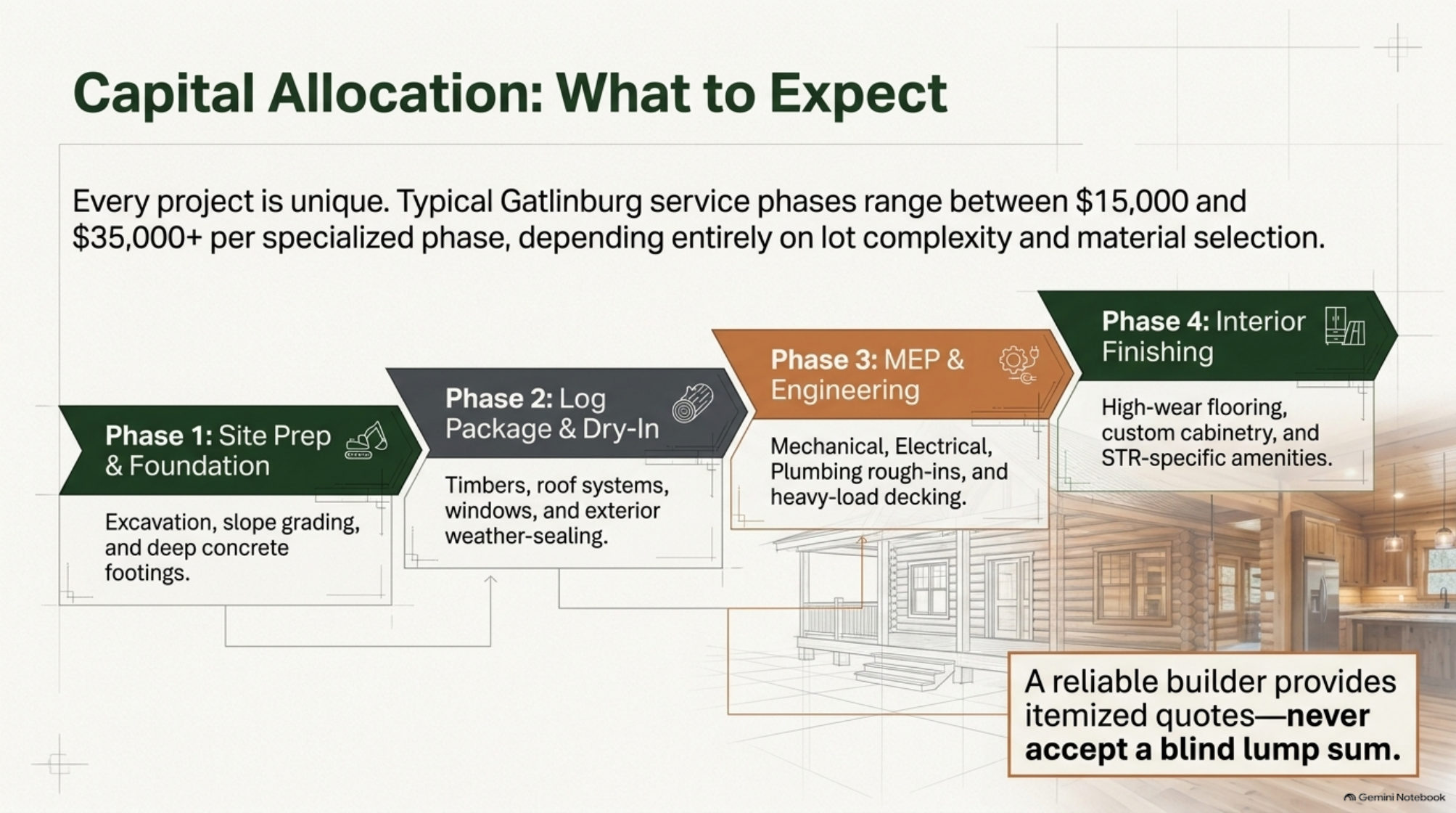
Slide 7 of our Building High-Yield Rental Cabins in the Smoky Mountains deck answers the question every investor asks after the lot is picked: what does the money actually buy, and in what order? Every project is unique, but typical Gatlinburg service phases range between $15,000 and $35,000+ per specialized phase, depending entirely on lot complexity and material selection. The deck breaks the build into four phases, and the rule that runs through all of them is that a reliable builder provides itemized quotes, never a blind lump sum.
This post walks each of the four phases and then shows how they stack up on a real worked example: a 2,200 sq ft luxury full-scribe cabin on an 18% slope, priced at $835,406. The percentages matter more than the price tag, because the same split tells you where a modest cabin and a high-end one each spend their money.
Phase 1: Site Prep and Foundation
Site prep is excavation, slope grading, and deep concrete footings, and on a Smoky Mountain lot it is where surprises live. The pad has to be cut and graded so the house sits level, the soil has to be stable enough to build on, and the footings have to go deep enough to ignore frost and slope movement. On steep ground this phase pulls in engineered retaining walls and drainage swales that protect the pad before a single log arrives; our steep slope construction guide covers that logistics in detail.
This is also the phase where lot complexity shows up first. A gentle, accessible lot with city water and sewer nearby prices very differently from a remote 18% slope that needs crane access and its own septic system. Budget-wise, expect the widest spread between quoted projects to come from this phase.
The Worked Example: $835,406 on an 18% Slope
To make the phases concrete, the deck analysis runs a worked example used throughout our cost material: a 2,200 sq ft full-scribe log cabin with luxury finishes on an 18% slope. The modeled total is $835,406, allocated 35% to site and foundation, 20% to the log package and dry-in, 25% to mechanicals and engineering, and 20% to STR-grade interiors. The table below shows what each slice buys.
| Phase | Typical range | Share | Worked example |
|---|---|---|---|
| Phase 1: Site prep and foundation | $15,000-$35,000+ | 35% | $292,392 |
| Phase 2: Log package and dry-in | $15,000-$35,000+ | 20% | $167,081 |
| Phase 3: MEP and engineering | $15,000-$35,000+ | 25% | $208,852 |
| Phase 4: STR-grade interiors | $15,000-$35,000+ | 20% | $167,081 |
The per-phase ranges describe typical specialized service phases; the worked example sits at the top end because full-scribe logs, an 18% slope, and luxury finishes push every phase higher. What stays consistent is the order and the split, which is why the full 2026 log home cost breakdown uses the same model down to the cubic yard of dirt.
Phase 2: Log Package and Dry-In
Phase 2 is the log package and dry-in: timbers, roof systems, windows, and exterior weather-sealing. This is when the cabin stops being a hole in the ground and becomes a building, and it is the phase where the profile choice from the blueprint deck gets paid for. Full-scribe handcrafted logs carry a premium over chink-style or post-and-beam packages, and the dry-in quality decides how the structure handles Smoky Mountain climate for the next fifty years.
Log delivery is a logistics event of its own: massive log packages arrive on flatbeds and often need a crane on site, which ties this phase back to the road grade and turning-radius evaluation covered in the slope construction post. Getting the package to the pad safely is part of the Phase 2 number, not an afterthought.
Phase 3: MEP and Engineering
Phase 3 is mechanical, electrical, and plumbing rough-ins plus the heavy-load decking. This is where the cabin gets its systems behind the walls, and where the revenue-critical structures get built: STR decks are engineered to 100+ psf commercial live loads because they carry hot tubs and crowds of guests, not just residents. The doubled-joist tub zone and deep footings described in our hot tub deck engineering post are priced into this phase.
Because rough-ins are invisible after the walls close, this is the phase where cutting corners is cheapest for the builder and most expensive for you later. Itemized quotes matter here more than anywhere: you want to see the deck engineering, the electrical service, and the plumbing rough-in as separate lines.
Phase 4: STR-Grade Interior Finishing
Phase 4 is interior finishing built for renters, not for the owner alone: high-wear flooring, custom cabinetry, and STR-specific amenities. The blueprint deck specifies luxury vinyl plank with a heavy commercial wear layer because it outlasts hardwood against ski boots, hiking gear, and pet claws, plus acoustic insulation between the game room and sleeping quarters and the dual-master layouts that keep adult groups booking. Those choices are what the finishing budget buys, and they are what protect the nightly rate.
Why Itemized Quotes Beat Blind Lump Sums
The deck closes with the rule that governs the whole process: itemized quotes, never a blind lump sum. A line-item bid separates excavation from framing, deck engineering from tub installation, and log package from dry-in labor, so you can compare two builders on the same scope and see exactly where money goes. A lump sum hides that comparison and makes change orders a negotiation instead of a calculation.
Model your own project before you ask for bids with our turnkey log home construction cost estimator, then check each phase against the 2026 cost breakdown so you walk into the quote conversation knowing what each phase should run in this market.
Frequently Asked Questions
Why will a builder not just give one total price?
Because on a mountain lot the variables are real: excavation depth, soil conditions, crane access, and finish grade all move cost. Itemized quotes separate excavation from framing and every other trade, so you can see where your project is expensive, compare builders on identical scope, and avoid change-order arguments later.
What pushes a phase above $35,000?
Lot complexity and material selection. Deep footings and retaining walls on a steep slope, full-scribe log packages, and luxury interior packages all move a phase to the top of its range. The $835,406 worked example for a 2,200 sq ft full-scribe cabin on an 18% slope shows every phase running above the typical band.
How should I compare phase quotes from different builders?
Ask for the same line items from each bidder, phase by phase, and check the totals against an independent model. The turnkey estimator and the 2026 cost post use the same audited assumptions, so they give you a neutral reference point before any contractor numbers arrive.